

Imagine planning a corporate event or incentive trip to a destination you have never visited before. Where do you start? How do you find the best venues, organize seamless transportation, or ensure your guests have an unforgettable experience? This is where a Destination Management Company (DMC) becomes your greatest asset.
Yet despite how central DMCs are to the corporate events and incentive travel industry, the term still causes confusion. What exactly does a DMC do? How does it differ from a standard event agency or travel company? And when does it make sense to hire one?
This guide answers those questions directly, with specific examples drawn from TERRAEVENTS' work across Europe.
1. What is a Destination Management Company?
2. What DMC services include: a full breakdown
3. How a DMC works: from brief to post-event
4. DMC Vs event agency: What is the real difference?
5. When should you hire a DMC?
What is a Destination Management Company (DMC)?
As we mentioned in one of our previous blogs, a Destination Management Company (DMC) is a professional services provider with in-depth local knowledge and expertise in organizing corporate events, meetings, and incentive travel programs within their specific country or region – for example, TERRAEVENTS operates over four countries (Italy, Spain, Portugal and France) with multiple offices in each destination, managing everything from intimate board retreats to large-scale incentives moving hundreds of delegates across multiple European cities.
The defining characteristic of a DMC is its rootedness in place. A DMC does not operate from a distance using a directory of subcontractors. Its teams live and work in the destination. They know which historic palazzo in Florence has the right acoustics for a gala dinner. They know the permit process for hosting an event in a UNESCO-protected square in Seville. They have a direct line to the sommelier at the estate in the Douro Valley that does not appear in any online search.
The Society for Incentive Travel Excellence (SITE) defines a DMC as “a professional services company possessing extensive local knowledge, expertise, and resources, specialising in the design and implementation of events, activities, tours, transportation, and programme logistics”. This definition captures the dual role well: a DMC is both a strategic partner and an operational one.
What DMC services include: a full breakdown
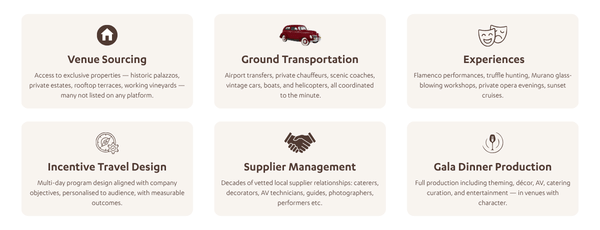
The scope of DMC services is broader than many clients initially expect. A strong DMC is not simply a booking agent with local contacts. It is an end-to-end programme manager, taking responsibility for every element of a delegate's experience from the moment they land to the moment they depart.
Incentive travel as a core DMC specialisation
Incentive travel is one of the most strategically important DMC service areas.
The 2025 Incentive Travel Index signals both the strength and the complexity of the market ahead. While growth continues, rising costs and geopolitical uncertainty are reshaping program design: 49% of DMCs anticipate activity above 2025 levels by 2027, and two-thirds of respondents believe younger qualifiers will drive a major retooling of what incentive travel looks like. This demand for values-aligned, personalised, destination-rich experiences is precisely where a DMC's local depth creates the most value.
A travel agency can book the flights and hotel. A DMC designs the entire program: the welcome moment, the experiential arc, the cultural immersion, the final-night crescendo, and delivers it with on-the-ground precision that no remote planning team can replicate.
How a DMC works: from brief to post-event

Understanding the DMC process helps clients brief more effectively, set realistic timelines, and get the most from the partnership. While every programme is bespoke, the working model follows a consistent arc.
- Briefing and discovery
The process begins with a detailed brief. A good DMC will ask about the objectives of the event (not just the logistics), the audience profile, budget parameters, preferred dates, and any non-negotiables. TERRAEVENTS uses this stage to understand the business context: what does the client need the event to do for the organisation?
- Concept and proposal
Based on the brief, the DMC develops a tailored program concept. This is where local knowledge becomes immediately visible: venue recommendations that are genuinely distinctive, experience ideas that are specific to the destination and the season, and a logistics plan that only someone with on-the-ground experience could produce. The proposal includes a detailed budget, timeline, and risk overview.
- Planning and supplier coordination
Once the proposal is approved, the DMC moves into detailed planning: contracting suppliers, conducting site visits, building run-of-show documents, managing delegate communications, and coordinating all moving parts. For a programme involving 300 delegates across three Italian cities over five days, this phase involves dozens of suppliers and hundreds of individual touchpoints.
- On-site delivery
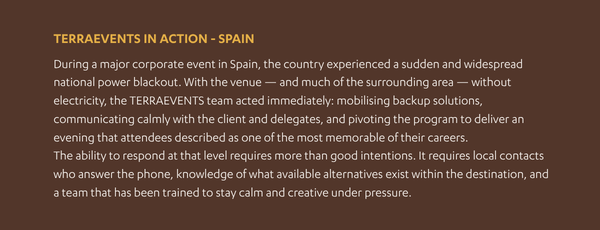
The DMC team is present throughout the program, managing every element in real time. This is where the value of a genuine on-the-ground partner becomes undeniable. When something unexpected happens — and in events, something always does, trust us! — the DMC's local contacts, regulatory knowledge, and operational agility make the difference between a disruption that the client never notices and one that derails the program.
- Post-event analysis
A professional DMC does not disappear when the last delegate boards the transfer. TERRAEVENTS conducts structured post-event reviews, gathering delegate feedback, reviewing supplier performance, auditing budget accuracy, and producing a debrief report that informs future programs. This closed loop is what transforms a one-off event into a long-term, improving client partnership.
DMC vs event agency: what is the real difference?

The distinction between a Destination Management Company and a general event agency is one of the most common points of confusion in the industry. Both plan events. Both work with suppliers. But the operational model, geographic depth, and accountability structures are meaningfully different.
Can a DMC and an event agency work together? The answer is YES.
An event agency typically operates at a global or national level, leading on creative strategy, brand alignment, content production, and client relationship management across many destinations. A DMC operates locally, embedded in a specific country or region, managing the on-the-ground delivery of everything that makes a destination come alive.
In practice, many event agencies bring in a trusted DMC as their local partner precisely because it would be impossible to hold that depth of local expertise in-house across every destination they serve.
|
Dimension |
DMC (e.g. TERRAEVENTS) |
Event Agency |
|
Geographic scope |
Deep roots in specific destinations; local team living and working in the region |
Operates across many destinations; brings in local specialists where needed |
|
Supplier network |
Long-term relationships with vetted local suppliers, venues, and vendors |
Broad supplier relationships across categories and geographies |
|
Regulatory & compliance |
In-depth knowledge of local permits, health and safety rules, and operational nuances |
Relies on local partners to navigate destination-specific compliance |
|
On-site presence |
Own staff physically present and managing delivery throughout the programme |
Often present for client-facing moments; local delivery managed by on-ground partner |
|
Exclusive access |
Access to venues, experiences, and contacts not available through standard channels |
Sources venue and experience options; a DMC partner unlocks the most exclusive access |
|
How they work together |
Provides the destination expertise, supplier relationships, and on-site execution |
Leads the client relationship and overall programme vision; DMC brings it to life locally |
It is also worth distinguishing a DMC from a PCO (Professional Conference Organiser). A PCO focuses on the operational and administrative management of conferences: registration, abstract management, sponsorship, and program logistics. A DMC focuses on the destination-specific, experiential, and logistical delivery of events and incentive programs within a given geography. Many complex events use both.
When should you hire a Destination Management Company?
The decision to engage a DMC is most clearly justified when one or more of the following conditions apply:
-
You are planning an event outside your home market. The moment your event crosses a border, the complexity (regulatory, logistical, cultural, linguistic) multiplies. A DMC eliminates this friction by providing a single, accountable local partner.
-
The experience quality matters, not just the logistics. If your event is an incentive program or a leadership retreat, the difference between a technically correct event and a genuinely extraordinary one is largely the difference between a logistics coordinator and a destination specialist with deep creative and cultural knowledge.
-
You are working with a large or complex group. Moving hundreds of delegates through a multi-destination European incentive program requires the kind of supplier network, operational infrastructure, and local knowledge that only a DMC with genuine in-destination presence can provide.
-
Risk management is a priority. The 2025 Best Practices for Managing Event Risk white paper found that only 36% of event planners have a dedicated risk management team, and just 52% create a formal crisis management plan for every event. A DMC with local presence and established supplier relationships fills this gap directl
-
You want exclusive access. Some of the most memorable event venues and experiences are simply not accessible through standard booking channels. They require direct relationships, local trust, and sometimes years of partnership with the people who control access. A DMC with genuine destination depth can open these doors.
Planning an event in Europe?
TERRAEVENTS is a specialist DMC across Italy, Spain, Portugal and France. Tell us about your program, and we will show you what destination expertise looks like in practice.
