

You already know incentive travel works. But the challenge is proving it to the CFO, to the board, to whoever signs off on the budget. What is the actual ROI of incentive travel?
The good news is that the data has never been stronger. Across employee retention, sales performance, productivity, and company culture, the research is unambiguous: well-designed incentive travel programs deliver measurable, significant, and lasting returns.
Here is the evidence and how to use it.
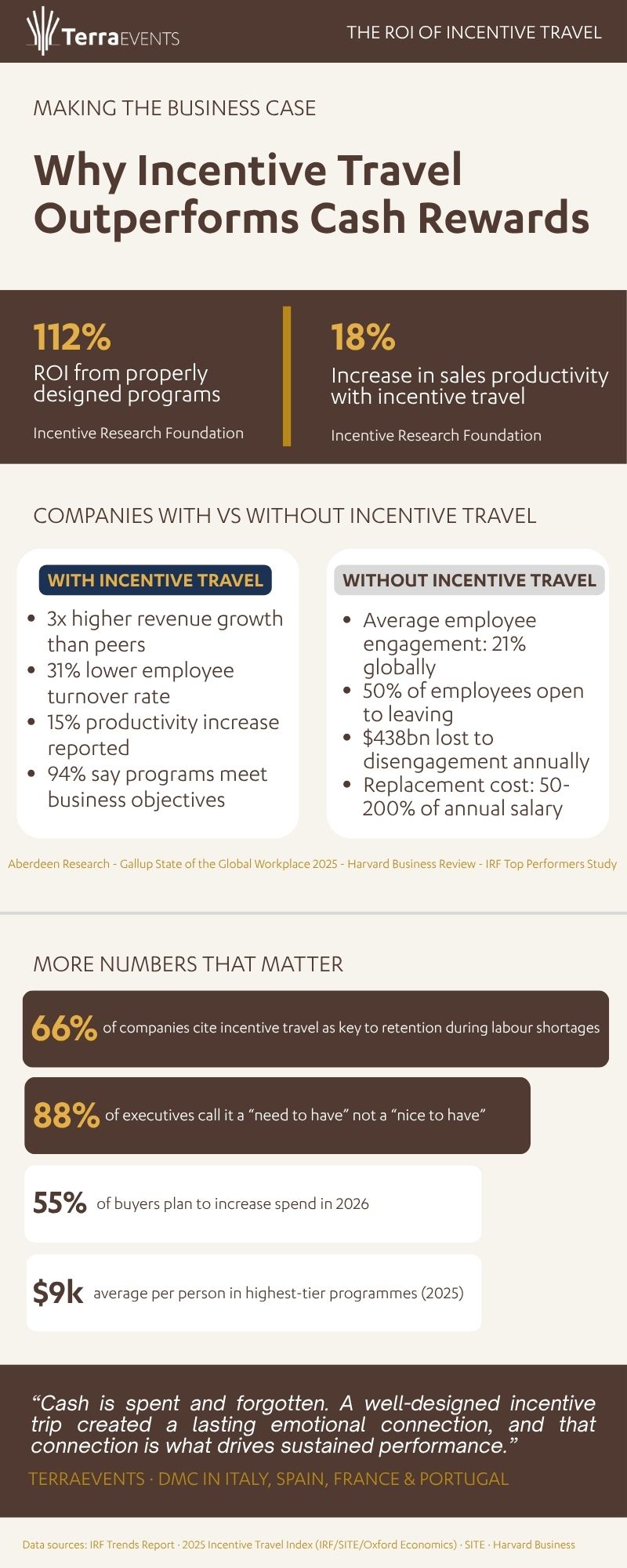
What the Numbers Say: Incentive Travel ROI at a Glance
So, what is the real ROI of an incentive trip? Research from the Incentive Research Foundation (IRF), has consistently shown that well-designed incentive travel programs can increase sales productivity by 18% and deliver a ROI of 112%. That is not a marginal return. It is more than doubling the value of the investment.
And the broader picture is just as compelling:
-
94% of top-performing companies say their incentive travel programs are effective or very effective at achieving business objectives;
-
88% of executives consider incentive travel a "need to have" rather than a "nice to have;"
-
55% of buyers expected to spend more on incentive travel in 2026 than in 2025;
-
The highest-tier incentive programmes averaged $9,000 per person in 2025 — more than double the spend of broad-participation programs.
Employee Retention: The Cost You Are Avoiding
Replacing an employee costs, on average, between 50% and 200% of their annual salary — depending on seniority, role, and industry. Incentive travel is one of the most effective tools for keeping top performers in place.
The data is consistent across multiple sources:
-
66% of companies report that incentive travel is a key tool for employee retention during a labour shortage;
-
Companies that implement effective travel incentive programs experience a 31% lower turnover rate among participants (Harvard Business Review, cited 2025);
-
90% of global buyers say incentive travel plays a critical role in talent retention;
-
50% of American employees are currently watching for or actively seeking a new job (Gallup, 2025).
That last figure is important context. In a labour market where half the workforce is at least passively open to leaving, retention-focused investment is not a luxury. It is risk management.
Sales Performance: The Direct Revenue Link
Incentive travel has its roots in sales motivation, and the performance link remains one of the clearest ROI arguments available to planners.
-
IRF research shows incentive travel can boost employee performance by 18% and generate a 112% ROI when planned effectively;
-
Sales performance improvements of 10% to 20% are reported in high-performing programmes where rewards are meaningful, and goal structures are clear;
-
A paint industry case study tracked by the IRF recorded 11.6% growth in ROI and an increase of 56,000 gallons sold after a six-month incentive program.
The consistent finding across studies: non-cash rewards, and incentive travel in particular, outperform cash bonuses at driving incremental, sustained performance improvement.
Cash is spent and forgotten. A well-designed exclusive trip to the Amalfi Coast is not.
Productivity and Engagement: The Wider Business Case

Beyond sales, the productivity case for incentive travel is increasingly well-evidenced, particularly relevant as global employee engagement continues to be a boardroom concern.
-
Employees who receive travel incentives report a 15% increase in productivity (SITE — Society for Incentive Travel Excellence);
-
85% of employees feel more valued when their company offers travel incentives;
-
79% of companies use incentive travel specifically to foster relationships between management and multi-generational staff;
-
84% of planners believe incentive travel is the most effective way to build company culture in remote and hybrid teams;
-
Global employee engagement stood at just 21% in 2024, costing the world economy $438 billion in lost productivity.
That last figure frames the opportunity starkly. Disengagement is expensive — and measurable. Incentive travel is one of the few tools that addresses engagement at an experiential, emotional level that surveys and salary reviews simply cannot replicate.
How to Present the ROI Case to Leadership
The data above is compelling, but it is how you present it that can truly make the difference.
Here is the framework that consistently works with senior leadership.
Step 1. Establish the baseline cost of disengagement. Use the Gallup figure: disengaged employees cost the global economy $438 billion in lost productivity annually. Then narrow it to your organisation: how many employees, what is the estimated engagement rate, what is the cost of turnover per role?
Step 2. Show the comparison benchmark. The IRF Top Performers Study consistently shows that top-performing companies invest nearly $3,000 more per salesperson on incentive travel than comparator companies — and their revenue figures reflect it.
Step 3. Lead with the 112% ROI figure. The IRF's research on properly designed programs returning 112% ROI is the most quoted and most credible single data point available. Use it as the anchor.
Step 4. Cite the retention savings. Calculate the cost of replacing one top-performing employee (typically 50–150% of annual salary). Compare it to the per-person cost of an incentive trip. A well-structured program that retains even one key person pays for itself.
Step 5. Build in measurement from the start. IRF research emphasises that the ability to demonstrate causality — proving that a program directly drove business outcomes rather than simply correlating with them — is often what separates programs that are renewed from those that are cut. To do this effectively, organisations should define success metrics before the program launches, such as sales uplift among participants versus non-participants, retention rates at six and 12 months, and engagement scores measured before and after the program.
The TERRAEVENTS Approach to Measurable Incentive Programs
At TERRAEVENTS, we design incentive travel programs across Italy, Spain, Portugal, and France with ROI built into the brief from day one. That means aligning the program design with the specific business objectives our clients are trying to move — whether that is retention among a high-performing sales team, re-engagement after a period of organisational change, or relationship-building between leadership and regional teams.
We work with clients to define the metrics before we suggest the destination. Because the most beautiful itinerary in the world delivers limited value if it is not connected to a clear business outcome.
So, if you are currently building the business case for your next incentive program or need help presenting the ROI argument to leadership, get in touch with one of our team!
