
It is ten o'clock on a warm evening in Seville, and two companies are hosting their corporate dinner a few streets apart.
In a hotel ballroom on the edge of the old town, two hundred people are on their third course and their second hour of speeches. Name badges are still on. A slide deck glows behind the CEO. Most of the guests landed at dawn, sat through sessions all afternoon, and are now quietly checking their phones and working out how little sleep they will get before tomorrow's 8am start.
A short walk away, in the courtyard of a sixteenth-century palace, a second group is lingering at long tables under the orange trees. Nobody is wearing a badge. A flamenco guitarist is tuning up in the corner, and the head of sales is deep in conversation with a graduate who joined the company six months ago. Tomorrow starts at ten.
Here is the part that surprises people: both companies spent almost exactly the same per head.
One of these trips will be forgotten before the expense reports are filed. The other will still be talked about next year, and some of the people at those tables will stay with the company partly because of it. At a time when only 20% of employees worldwide feel engaged at work (lowest level since 2020), according to Gallup's State of the Global Workplace 2026, that difference is worth a great deal.
It isn't luck, and it isn't the venue. It comes down to a handful of choices most guests never see, and that the best planners are now making on purpose. We watch both kinds of evening unfold every season, from Andalusian courtyards to London's private members' clubs. These are the five shifts that separate them – and that will shape corporate events in 2027.
1. How will AI change corporate event planning in 2027?
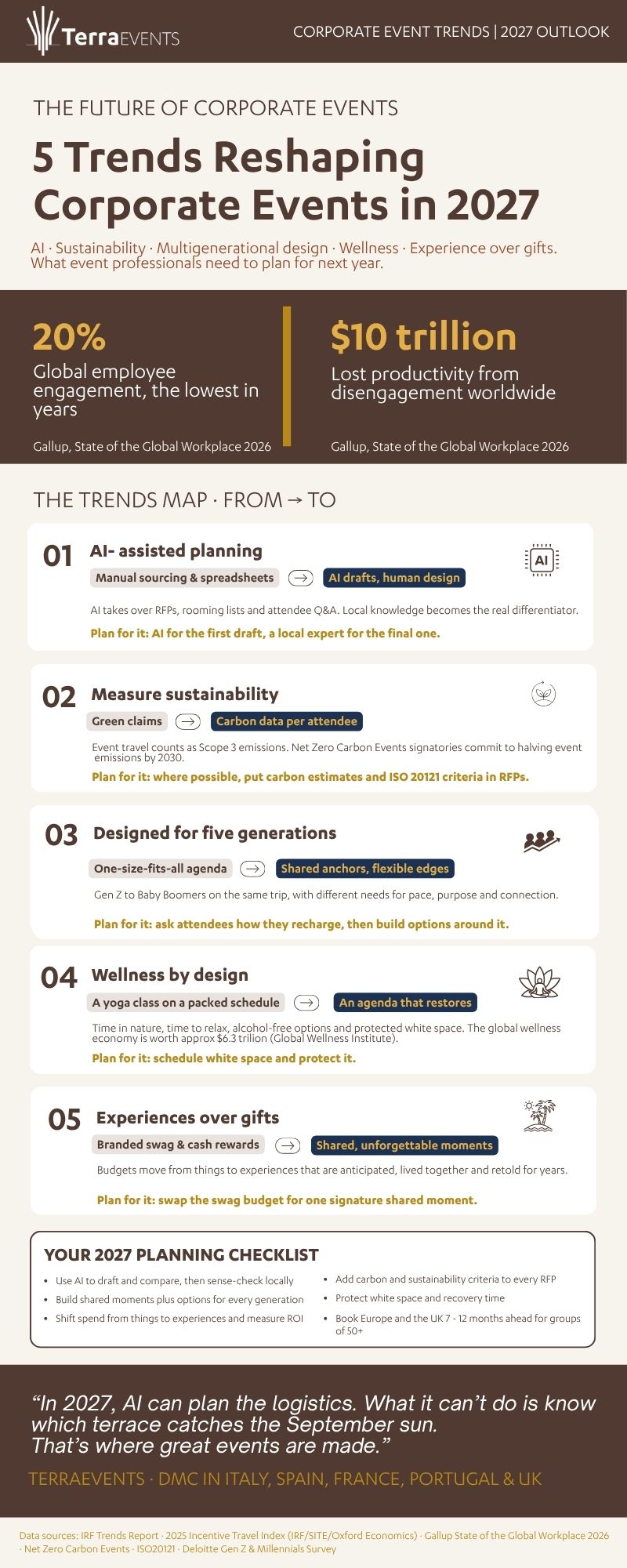
In 2027, AI will do most of the repetitive work behind a corporate event: drafting run-of-shows, comparing venue proposals, building rooming lists, answering the same attendee question for the fortieth time, and the planners who use it well will spend the hours they win back on design. The Incentive Research Foundation has tracked AI moving steadily into meetings and incentive work, and most of the event teams we work with now use it every day.
The surprising part is not the speed. It is what becomes rare. Ask any AI for the ten best venues in Lisbon for 200 guests, and you will get a perfectly sensible list – most probably the same one your competitor got this morning! What no model can tell you is which terrace actually catches the evening sun in late September, which family-run estate in Chianti will close its gates for a private group, or how Seville moves during Feria week. That knowledge lives with the people who walk those streets, and in 2027 it becomes the real advantage.
There is a quieter benefit too. With registration data doing more of the work, every guest can receive an itinerary that feels made for them – dietary needs already known, sessions already suggested – without adding anyone to the team. The responsibility grows with it. Attendee data handled by AI tools still falls under GDPR in the EU and its UK equivalent, and the EU AI Act adds transparency duties for some uses, so it is worth asking every partner exactly where your guests' information goes.
The best event planners we know treat AI like a brilliant junior assistant: it writes the first draft, never the last one.
2. Why is sustainability becoming non-negotiable for corporate events?
Sustainability becomes non-negotiable in 2027 because companies increasingly have to report the emissions from their business travel and events – and because attendees can now tell the difference between real action and a reusable water bottle. Under the GHG Protocol, event travel counts as Scope 3 emissions, and it is turning up in climate targets and supplier questionnaires that once ignored it.
For years, "sustainable event" mostly meant good intentions: paperless agendas, a tree planted somewhere, a line in the closing speech. That era is ending. More than 500 organisations have signed the Net Zero Carbon Events pledge, committing to halve event emissions by 2030, and procurement teams increasingly check suppliers against ISO 20121, the international standard for sustainable event management. The question in 2027 is no longer "is it green?" but "how much carbon, per attendee, and how do you know?"
The encouraging news is that the most sustainable choices are often the most memorable ones. Flying everyone to one well-connected destination and staying longer usually beats a hurried multi-stop tour. Taking the train from London to Paris, or from Madrid to Barcelona, turns a transfer into part of the experience. A menu built around what was harvested that week in Puglia or the Alentejo tastes better than anything flown in. And an afternoon spent with a local conservation project leaves something behind that no branded tote bag ever will.
The simplest way to make it happen is to ask for a carbon estimate in your RFP, at proposal stage. Suppliers respond to what you measure.

3. How do you design a corporate event for a multigenerational workforce?
You design for a multigenerational workforce by offering choice inside a shared program: a few moments that bring everyone together, and freedom in between for each person to take part in their own way. In 2027, it is normal for a single incentive trip to include a 25-year-old in their first sales role, a millennial team lead, a Gen X director and a Baby Boomer board member – all at the same dinner table.
Imagine planning one evening for all four. The new hire wants something they will remember and, if we are honest, something worth posting on socials. The team lead wants a conversation that doesn't compete with loud music. The director wants to be back at the hotel at a reasonable hour. The board member wants to understand where they are (the history of the place, the people who make the wine, etc.). Design for the "average" guest and you disappoint all of them.
Research points the same way. Deloitte's annual Gen Z and Millennial Survey consistently finds younger employees weighing purpose, balance and learning heavily when they judge an employer, while more experienced colleagues often value pace, comfort and depth of conversation.
The programs that work best keep two or three anchors that everyone shares – the welcome dinner, the keynote, the closing celebration – and offer real choice around them. On the same Douro Valley afternoon, one group can take e-bikes through the terraced vineyards while another sits down for a slow tasting with the winemaker. Mixed-age formats, such as small teams or reverse mentoring, turn the age gap into a strength rather than a fault line. And step-free venues, shorter walking distances and quiet corners help everyone, not only older guests.
One question on your registration form, like "How do you like to recharge?", will tell you more than any generational profile.

4. What does wellness programming at corporate events look like in 2027?
In 2027, wellness at corporate events means shaping the whole agenda so people come home with more energy than they left with – not squeezing a yoga class into an exhausting schedule.
Most of us know the old model by heart. Land at dawn, go straight into sessions, network through dinner, close the bar, and fly home on Sunday needing a holiday. It was designed to squeeze the most out of every hour, and it usually squeezed the most out of the people instead.
The programs that feel different in 2027 start from a simple idea: rest is part of performance. The first morning after a long flight begins late. Lunch is a real lunch, not a sandwich during a breakout. Somewhere in the day, there is a swim in the Mediterranean, a walk along the Algarve cliffs, or an hour in an English country-house garden with nowhere to be. Every bar offers a good alcohol-free option, and nobody has to explain why they chose it.
The hardest part is the simplest: leave white space in the agenda and defend it when someone wants to fill it. Some of the best conversations of any event happen in the hours nobody scheduled.
5. Why are companies moving budget from corporate gifts to experiences?
Companies are moving budget from gifts to experiences because a shared experience builds memories and relationships that no branded object can – and the research on non-cash rewards supports the shift. The Incentive Research Foundation's 2026 Trends report found that 55% of incentive buyers planned to increase spending in 2026, and the 2025 Incentive Travel Index, produced with SITE and Oxford Economics, shows the sector still growing worldwide.
Go back to those two dinners in Seville. On the way out of the ballroom, every guest was handed a branded fleece. Somebody chose it carefully, ordered it in four sizes and shipped it across a continent; most will end up at the back of a wardrobe. The courtyard group went home with nothing to carry except a story: the guitarist, the orange trees, the conversation that ran past midnight... Nobody packed it in their suitcase, yet everyone took it home.
That is the psychology behind the trend. A gift is used once and forgotten. An experience is looked forward to, lived together and retold for years – and "together" is exactly what hybrid and distributed teams are missing. It is why more companies are choosing fewer, richer programs over bigger, thinner ones, and why top performers increasingly earn a trip rather than a cash bonus or a catalogue reward.
Gifts don't disappear; they simply get better. One meaningful object from the place itself (e.g. olive oil from the estate you visited, a hand-painted azulejo tile from Lisbon) means far more than a bag of logo merchandise. And because finance teams will ask, it pays to link each program to clear goals such as retention, sales targets or engagement scores, and to measure before and after. Our earlier infographic on the ROI of incentive travel shows what the numbers look like.
So here is the swap to try in 2027: take the swag budget and put it into one unforgettable shared moment. People will still be talking about the dinner long after the water bottle is gone.
What do these trends mean for event planners in 2027?
Think back to that courtyard in Seville. It wasn't luckier than the ballroom, and it wasn't more expensive. Its planners let AI handle the admin and spent the time they saved on design. They knew what the evening would cost the planet, built a program that worked for the graduate and the head of sales alike, left room to breathe, and swapped the fleece for a night nobody will forget. That is the corporate event of 2027, and the partners you choose on the ground will decide which kind you host.
None of this needs a bigger budget. It needs better questions at the very start of planning:
- Where can AI save us time?
- What will this event cost the planet, and can we prove it?
- Will it work for the youngest and the most senior person in the room?
- Where is the white space? And what is the one moment everyone will still be describing a year from now?
Planning a corporate event, retreat or incentive trip in Europe or the UK for 2027? TERRAEVENTS designs and delivers programs across Italy, Spain, Portugal, France and the United Kingdom, with local teams who know the territory, the venues, the seasons and the people. Talk to our team to start shaping your next event.
